According to the definition of IEEE-STD-1220-1998, requirements are statements that define the operability, functionality, or design characteristics or constraints of a product or process and are explicit, testable, or measurable, and have an impact on the product or process. The acceptability is required. In autonomous transportation systems, the definition paradigm is as follows:
In <specific scenario>, <user principal> is capable of <capability> under <operating condition> when <event name>.
For example:
In the <vehicle-road collaboration scenario>, when <crossing the street>, the <non-motor vehicle driver> can <perceive the presence of a moving vehicle> in <areas with restricted vision such as curves, intersections, narrow streets, etc.>.
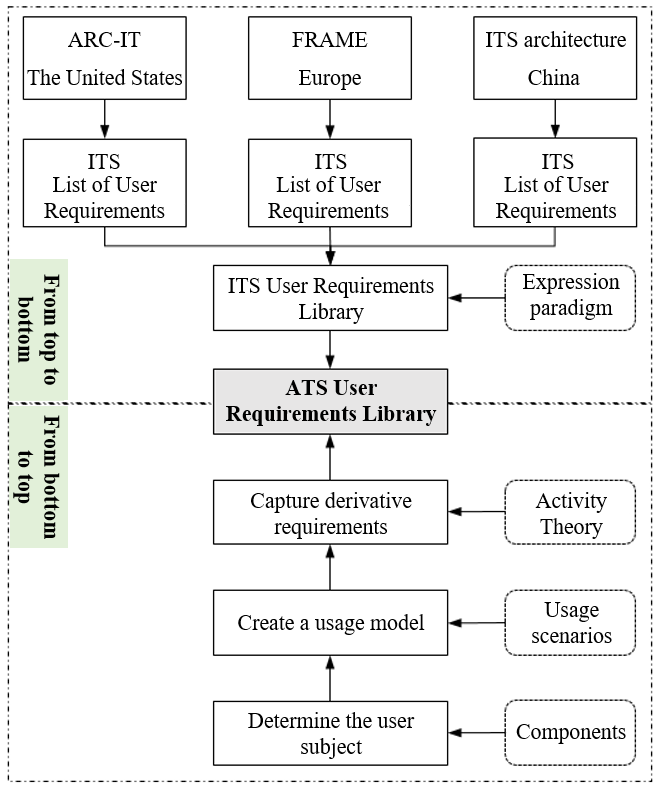
Research on ATS needs is divided into top-down user needs summary for ITS and user needs deduction based on activity theory. Through the integration of user needs from the two ideas, ATS is formed. User need set 。
The top-down demand summary is mainly to sort out the ITS user demand system similar to ATS, and analyze the different logic and expression of user needs in the American ARC-IT, European FRAME and Chinese ITS system frameworks. By integrating user needs and unifying the expression paradigm, a relatively complete ITS user demand library is established, which is also a basic user demand library for ATS.
The bottom-up demand deduction is based on activity theory and is oriented to the user subjects whose components are determined. It constructs a research category with travel mode as the basic scenario and activity as the center, and connects the components of the transportation system with safety, convenience, efficiency, Green and economical goals capture user-derived needs and build an ATS user demand library, and then use the contradictory ideas in activity theory to analyze the development of travel and transportation activities and the evolution of user needs.